America's wealthiest 1%, according to my research, have always been focused on maintaining the stability of our monetary system, whether that system is based on gold or, since 1973, on oil.
With this post we continue to explore connections mentioned by JFK assassination researcher Lisa Pease, author of "David Atlee Phillips, Clay Shaw and Freeport Sulphur," who focused on the sulphur company during times it was headed by John Hay "Jock" Whitney. Originally published in Probe, Pease's article discusses Freeport Sulphur's international nature as well as its close ties to happenings in Cuba during the time JFK was President.
Valuable in the insight Pease's article gives us into the role of the Central Intelligence Agency's use of Freeport Sulphur, nevertheless it does not ask who really owns and operates the CIA itself. Perhaps looking back deeper into the company and its formative years will help in answering that question.
Who Was Jock Whitney?
Jock's father was William Payne Whitney, commonly known simply as Payne. As a youngster, Payne Whitney was caught in a feud between his father and his mother's brother, Oliver Payne, following her death in 1893. Promised a share of Oliver's wealth, he turned against his own father, who had married Edith Randolph, a woman scorned by the Payne family, whom he had been seeing before his wife died. According to the New York Social Diary website:
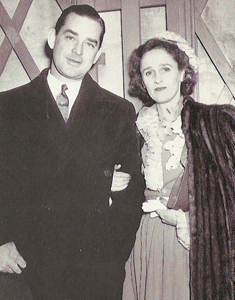
Jock and Betsy Cushing Whitney
In 1902 [William Collins] Whitney’s son, Payne Whitney, who’d sided with Oliver Payne, married Helen Hay from Cleveland, Ohio. Miss Hay was the daughter of John Hay who had been private secretary to President Lincoln and later Ambassador to the Court of St. James under President McKinley. Mr. Whitney who, like his father, went to Yale, was 26. For a wedding gift, Col. Payne gave the couple a Stanford White house at 972 Fifth Avenue.... After the Second World War, he started an investment fund, run by a friend he’d met in the War, to invest in new ideas of the men coming back from the War. He called it Adventure Capital and later dropped the “ad” to coin the now established term: venture capital. He was known for his ventures in Hollywood (“Gone With the Wind”), his industrious ventures, as well as being the last publisher of The New York Herald-Tribune.... Like his grandfather, he was also the Ambassador to the Court of St. James (under Eisenhower). Married twice, first to a beauty who loved horses more, and finally to Betsey Cushing Roosevelt, daughter of the famous brain surgeon Harvey Cushing, first wife of FDR’s son’s James, to whom he [Jock] remained married to the end of his life.... The Payne fortune, inherited by Payne Whitney, and then his children, grew far larger than the fortune left by William C. Whitney to his children. That was partly due to the fact that Harry Payne Whitney and Gertrude Vanderbilt produced more offspring who produced more offspring. Jock Whitney produced no off-spring, and his investments after the War catapulted him (and partially his sister [Joan Whitney Payson]) into the realm of what are now billions.
972 Fifth Avenue mansion
Payne Whitney had inherited his uncle's huge mansion in New York, and the 1920 census shows Jock and Joan living there with their parents--only four people at 972 Fifth Avenue--being cared for by fifteen servants, none of whom were American-born. Payne's business address, 14 Wall Street, was the Bankers Trust Company, set up by the White and Case law firm in 1903, and was controlled by J.P. Morgan affiliates in the days prior to the creation of the Federal Reserve banking system. Before 1930 Morgan bankers controlled United States government policy on currency. According to economist Murray Rothbard, the first governor of the New York Federal Reserve Bank was:
Benjamin Strong, who had spent virtually his entire business and personal life in the circle of top associates of J.P. Morgan. A secretary of several trust companies (banks doing trust business) in New York City, Strong became neighbor and close friend of three top Morgan partners, Henry P. Davison, Dwight Morrow, and Thomas W. Lamont. Davison, in particular, became his mentor, and brought him into Morgan's Bankers Trust company, where he soon succeeded Lamont as vice-president, and then finally became president. When Strong was offered the post of Governor of the New York Fed, it was Davison who persuaded him to take the job....The main collaboration throughout the 1920s, much of it kept secret from the Federal Reserve Board in Washington, was between Strong and the man who soon became Governor of the Bank of England, Montagu Collet Norman. Norman and Strong were not only fast friends, but had important investment-banking ties, Norman's uncle having been a partner of the great English banking firm of Baring Brothers, and his grandfather a partner in the international banking house of Brown Shipley and Co., the London branch of the Wall Street banking firm of Brown Brothers. Before coming to the Bank of England, Norman himself had worked at the Wall Street office of Brown Brothers, and then returned to London to become a partner of Brown Shipley.
The Role of Brown Brothers Harriman Montagu Norman had been called "the currency dictator of Europe" by the Wall Street Journal in 1927. Thus, when the U.S. government witnessed the decline of the Brown Brothers investment bank in 1926, it felt the need to shore it up with an infusion of capital and turned to the two Yale educated sons of robber baron E.H. Harriman to do so. Averell and Roland (Bunny) Harrison were the Skull and Bones friends and eventual partners of Prescott Sheldon Bush, the father and grandfather of two future presidents.
It is no coincidence that America's earliest attempts at setting up intelligence agencies called upon the talents of the sons of Wall Street bankers. Idealistic principles often fall by the wayside when big money is involved, and it is the wealthy elitists who think they have the most to lose in the games played in international market manipulations. The poor have only their lives, and are often treated as cannon fodder by such elitists on every front.
In the years between the two "great" wars the Brown Brothers partner, Montagu Norman, was actively concerned with handling Germany's reparations payments, working with the first head of the Bank for International Settlements, Gates McGarrah, whose grandson, Richard McGarrah Helms, would later head the Central Intelligence Agency.
Within six months after the above photos appeared in the news, Norman had found the perfect rich kids to entice with the power of helping to run the world. Their father's death in September 1909, when the boys were mere teenagers, had been the top headline in newspapers throughout America. Their mentor became the man most trusted by their father to run his business, Robert Scott Lovett, who would see that the boys were educated at Yale alongside his own son, Robert Abercrombie Lovett. All would rise to power in the government as the second great war approached, with help from their brothers in Skull and Bones.
Prescott Bush, center, with Brown Brothers Harriman partners--Bunny Harriman, Knight Woolley, and R.A. Lovett
By following the money, you often learn how the world really operates, who works for whom, so to speak.
Oliver Stone relates in his book, The Untold History of the United States:
Prominent among the American capitalists with ties to Nazi counterparts was Prescott Bush, the father of one president and grandfather of another. Researchers have been trying for years to determine the precise nature of Bush's ties to Fritz Thyssen, the wealthy German industrialist who played a crucial role in bankrolling Hitler, as revealed in his 1941 memoirs I Paid Hitler. Thyssen ultimately repudiated the Nazi dictator and was himself imprisoned. While incarcerated, Thyssen's vast wealth was protected overseas, much of it by the investment firm of Brown Brothers Harriman, through the holding company Union Banking Corporation. The account was managed by senior partner Prescott Bush.
About ten years younger than the Harriman boys, Jock
Whitney and his sister sat atop a huge pile of money which they would make available to those
in power engaged in manipulation of international currency. Although Jock went to Yale, he was tapped for Scroll and Key, rather than the Bones secret society, and was a mere two years behind Scroll and Key member James Stillman Rockefeller (son of Elsie Stillman and William G. Rockefeller), whose Uncle Percy, married in 1901 to Elsie's sister Isabel Stillman, was a member of the Skull and Bones class of 1900. Only a year after his Yale graduation, James Stillman Rockefeller had united fortunes with the Carnegies by marrying the niece of the steel magnate whose fortune had been liquidated by the Morgan bank. Five years later, Chase Manhattan bank would acquire the Equitable Trust, another Morgan affiliate--thus shifting control of the New York Fed in 1930 from Morgan to Rockefeller-owned banks at the same time Freeport Sulphur's control shifted under the leadership of Langbourne Williams, Jr., a Stillman son-in-law, as will be detailed in the next installment.
George Walker Bush called Karl Rove his "Brain". Part of the story has been told many times. Paul Begala, Rove's Democrat counterpart said of one book, Bush's Brain: How Karl Rove Made George W. Bush Presidential, by Wayne Slater and Jim Moore:
"Love him or hate him, Karl Rove is one of the most brilliant and
successful political consultants of all time."
Brilliant, yes. But what makes him successful as a Republican strategist is that atavistic ability to lunge for the jugular and not let go. It is a trait that has come to epitomize Republican politics--at least the political game played by the strategists who get paid to manage the campaigns of of all levels of candidates running for office today.
RNC Head Picks Winner
It was an auspicious meeting between 23-year-old Karl and George H. W. Bush in 1973 which sealed the younger man's meteoric rise within his chosen career. Rove was vying for
the chairmanship of the College Republicans against his more traditional
opponent, Robert Edgeworth, who heartily embraced Barry Goldwater in that year when Bush was dubbed as chairman of the Republican National Committee at the height of the politically disastrous Watergate scandal. Given the choice between Rove and Edgeworth, the seemingly mild-mannered Bush picked Rove hands-down, according to a 2003 article by Nicholas Lemann in The New Yorker. [1] The meeting would become only the first step in a long-term relationship between Rove and Bush, leading, as it turned out, to an even more co-dependent association between Rove and Bush's son, "Dubya".It was all about getting into power, which seemed like an impossible dream in those days after Watergate.
George Bush was, at that
moment in time, frustrated because former Goldwater idealists,
disgusted by Watergate shenanigans, were abandoning politics in droves.In
their place, new power was being handed to a youthful electorate within
the College Republican organization, whose value to the Party promised
an abundance of gratuitous labor and an almost self-sufficient network
of grassroots volunteers. Senator
Carl T. Curtis summed it up well when he said:
"I can think of no other
political organization which can give conservatives a bigger 'bang per
buck.' " [2]
George Bush’s Political Secrets
In
1972 the 48-year-old George Bush had already experienced a varied career
in both business and public life. A Navy pilot in World War II, he
completed his studies at Yale in 1950 (Skull and Bones) and moved to
Texas to engage in the oil business. Financed largely by clients of his
father and uncle with connections to the investment banks of Brown
Brothers Harriman and G.H. Walker & Co., he worked first for a subsidiary of Dresser Industries (now part of Halliburton), which was then wholly owned by Brown Brothers Harriman, of which his father (Senator Prescott Bush) was a senior partner with a veritable coven of Skull and Bones bankers--Averell and Roland Harriman, Knight Woolley and Robert A. Lovett.
Prescott Bush in Brown Brothers Harriman office with Bonesmen partners Bunny Harriman, Knight Woolley and Lovett
After
more than a decade in Texas, having attached himself to wealthy Texans
Bill and Hugh Liedtke, W.S. Farish III, and Robert Mosbacher, Bush
thought he had gained sufficient backing to enter the political fray. He managed to win election twice to a Republican Congressional seat from
a wealthy precinct in Houston in 1966 and served until 1970 when then
President Nixon, anticipating an important vote concerning China’s
status to that body, appointed him to be Ambassador to the United
Nations.
When
hell broke loose over Watergate, Sen. Bob Dole, who had replaced Rogers Morton at the Republic National Committee, quickly resigned, and Bush took over in January 1973. Nixon had placed the real
political power of his office in the hands of his former law partner,
John Mitchell, who headed the Committee to Re-Elect the President
(CREEP), the source of the scandal to begin with. By placing Bush at the
RNC, the White House was hoping for more loyalty to Nixon than Dole had
shown. And, too, Bush was also there to cover his own misdeeds and
those of his fellow fundraisers, referred to on the “smoking gun” tape
as “the Texans,” disclosure of whose role in the campaign could have
revealed “the whole Bay of Pigs thing,” according to Nixon. [3]
Though
conspiracy theories abound, George Bush’s real role in Republican
politics during the Kennedy years remained buried, at least until publication of Russ Baker's ground-breaking book, Family of Secrets. Bush would have
even more opportunity to cover up prior dirty tricks when President Gerald Ford
appointed him Director of the C.I.A. late in 1975.
There's a Lesson There
Segretti
Keeping
the lid on the secrets being uppermost in his mind, when the
stressed-out Bush met the arrogant and ebullient Rove in 1973, he was,
therefore, inspired by the young man’s optimistic spirit, as well as his
ability to engage in the same dirty tricks that were to land Donald
Segretti in a prison cell. Segretti, one of many "advance men" that had
been hired by CREEP to disrupt Democratic campaigns during the 1972
primary season through acts of political sabotage and espionage, once
distributed a letter falsely claiming that former Senator Henry M.
"Scoop" Jackson had fathered an illegitimate child with a 17-year-old
girl. He pled guilty in 1973 to three counts of distributing illegal
campaign literature.
In
1970, it has been often reported, Rove, while working for a Republican
candidate and pretending to be a Democrat volunteer for that opponent,
removed two reams of stationery from the Democrat's office which he used
to advertise the opening of his headquarters, adding "free beer, free
food, girls and a good time for nothing." [4] Stories about such successes were undoubtedly boasted about at College Republicans training weekends. Karl Rove was a fast learner.
While
the Watergate scandal was at its peak, Rove’s opponents for the College
Republican position—Terry Dolan and Robert Edgeworth—leaked to the Washington Post
a tape recording of an amused Rove and another College Republican,
recounting their antics and campaign espionage during previous political
campaigns. The story that appeared in the Post ran under the headline
“GOP PROBES OFFICIAL AS
TEACHER OF TRICKS”
Republican Chairman George Bush was not amused. Edgeworth told the New Yorker, “Bush sent me ... the angriest letter I have ever received in my life. I had leaked to the Washington Post, and now I was out of the Party forever. That letter is a family heirloom." [5] In contrast, Bush rewarded Rove with a full-time job at the Republican National Committee. There’s a lesson there somewhere.
Rove's Rise to Fame
Lee Atwater
The manager for Rove's 1973 CRNC campaign was none other than 22-year-old southerner,Lee Atwater,
who would become famous for his killer political instincts seven years later,
after George Bush hired him as strategist in his post-Watergate campaign for
the presidency. Rove's own fame came hot on Atwater's heels.
While
a high school senior in Salt Lake City he worked in the campaign of Utah
Senator Wallace F. Bennett and got his first taste of political
strategy. As a freshman political science student at the University of
Utah he interned for Ralph Tyler Smith’s 1970 U.S. Senate campaign
in Illinois and so overwhelmed his College Republican boss that he was rewarded with the job as executive director of the College Republican National Committee
(CRNC), located in Washington, D.C., no less. [6]
The
move to the nation’s capital would be a heady experience for
Rove, a nerdy lad who already had an established history of impatience and even
brazenness. As a protege of the College Republicans' national chairman, Joe Abate (now a lobbyist), Rove soon met others with his taste for political blood,
including his former campaign manager Lee Atwater, as well as Roger Stone and Terry Dolan—each of whom was trained in the
College Republican stable to be a political consultant for the
conservative cause. A decade later, equally adept, yet unprincipled,
trainees—Jack Abramoff, Ralph Reed and Grover Norquist—joined them there. [7]
Baby-faced Ralph Reed was anointed by Pat Robertson to head the IRS-designated not-for-profit 50l(c)(4) organization, the Christian Coalition. Time magazine in 2006, at the time of his fall from grace,quoted Reed, during the peak of his hubris, in a not-so-Christian moment, likening his political role to a jungle killer fighting a war:
Reed with Pat Robertson
"I do guerrilla warfare," Reed once boasted
to a reporter, describing how he ambushed his enemies as a political
operative. "I paint my face and travel at night. You don't know it's
over until you're in a body bag."
Rove's Background
Under
Rove, direct mail—a dirt path blazed by Richard Viguerie—would be
paved. The simple mailing list would be broadened to establish ideological coalitions
spanning the nation. The Republican political base would be analyzed and broken down into categories with enthusiastic young ideologues appointed to raise money from each segment by preaching to their respective choirs about their candidates.
Because 1972 was the first year that
eighteen-year-olds could vote, the CRNC became an official auxiliary to
the Republican Party, and its chairman (Rove) was made an ex officio
member of the national committee’s executive committee. Quite a step up
for a young man of Rove’s age. At the same time, emotional upheavals in
Rove's family life intensified the experience, as he traveled to his hometown of Sparks, Nevada, to check in on his mother and found himself profiled in the Reno Evening Gazette on January 31, 1972, which described him as:
a political science and history major at George Washington University in Washington, D.C., where the College Republican National Committee has its offices. He attended Florence Drake Elementary School and Dilworth Junior High when he lived in Sparks.
The paper also proudly proclaimed his other achievements:
Former Sparks [Nevada] Youth Named To Who's Who
Karl Rove, the 21-year-old son of Mrs. Reba Rove of Sparks, has been appointed to Who's Who of Outstanding Young Men of America.
The upheaval involved Karl's being told by an aunt that Louis Claude Rove, Jr. was his adoptive, rather than his biological, dad. He also discovered that Louis was, in fact, gay. Even though Karl would continue to raise funds from the anti-homosexual Republican base constituents by bashing gays, he came to terms with his father's lifestyle.
Karl's mother, the former Reba Wood, was divorced from Louis on May 25, 1970 in Reno, Nevada, where Reba took her family to live after giving up her gift shop in Salt Lake City. Reba had met and married Louis while he was a student at the Colorado School of Mines in Denver, when Karl and his brother Eric were quite young. The name of their real father, her first husband, is unknown. Louis' graduation and marriage occurring at the beginning days of the 1950's uranium boom, led to one of his first jobs at Climax Molybdenum Co. in Salt Lake City, Utah. By 1966 he was chief geologist at Vitro Minerals Corp., created under supervision of the Atomic Energy Commission during the peak of the boom in 1955.
Louis Rove's Resume
From Louis Rove's Who's Who listing
(Note: This blog previously explored a contract between LBJ friend, Morris D. Jaffe, and the Climax uranium company, as well as uranium mining companies owned by Dallasite, D. Harold Byrd. Readers can search this blog or scan tags for more on these subjects, by finding these tools in the frame to the right.)
According to Climax's company history, it merged in 1957 with the non-ferrous metals mining company, American Metal Company (Limited)--the majority of whose stock in 1918 had been placed in a voting trust for its British alien owners, though the company president was an American, Carl M. Loeb (father of John L. Loeb). After the war it became
American Metal Climax, Inc., still controlled by the Loebs, evidenced by the fact that Carl M. Loeb Jr.,
"a metallurgical engineer, ... was an executive with the Climax Molybdenum
Company, which later became AMAX Inc. [in 1974]. He was also a limited partner in
Loeb, Rhoades and Company, a brokerage and investment banking firm
that his father, Carl Sr., and his brother John had helped found, and
that was later merged into Shearson and then American Express."
Rove’s father and mother, Louis and Reba Rove, were listed in a local
[Sparks] city directory beginning in 1961. Louis Rove was a geologist with the
Utah Mining Company (one of the six corporations that built Hoover Dam).
At the time, the Roves were living at 2195 Nelson Way, a block east of
Pyramid Way and just north of the then relatively new Greenbrae Shopping
Center.
By 1962, Louis Rove’s title had changed to regional manager and the
corporation’s name had changed to Utah Construction and Mining Company [UCM].
In 1963, the Roves moved to 149 East Gault in Sparks. Karl was the
second of five children in the family. His brothers and sisters were
Olaf, Reba, Eric and Alma.
Reba had been born in New Mexico in 1929 to Robert G. and Elsie Wood of Pueblo, Colorado (her father died there in 1973). Prior to her divorce and employment, she had been active in a women's group, Beta Sigma Phi, in Reno since moving there and served as president of the Reno-Sparks city council prior to 1966.
After her 1970 divorce from Louis, her name sometimes appeared in the news as the coordinator for the Senior Citizen Resource Center, which handled the "meals on wheels" and similar programs for seniors in Reno's Washoe County, but it also announced her resignation from that post in May 1972. Karl's sister, Reba, who was only ten when her parents divorced, became a high school cheerleader. She and her sister Alma were also active in the local chapter of Rainbow Girls, a Masonic-connected society. In 1973 Alma married John Robert Monroe, but divorced him four years later.
It is quite likely that Reba had met her last husband, Lowell Henry Brinson, while she worked at the senior center in Reno. The son of a California railroad porter, he was regional coordinator in Stockton, California in 1968 for the Foster Grandparents Program, before moving to Reno to become Nevada's state director for ACTION, a new federal volunteer agency. Lowell and his wife Shirley had divorced soon after filing bankruptcy in Reno in late 1969--at the exact same point in time Louis Rove abandoned his family to take up a full-time gay lifestyle. They married in Los Angeles, California, on May 17, 1981, the same year she purportedly committed suicide. Although her suicide was mentioned in Time magazine, while reviewing The Architect, the marriage to Brinson was omitted:
In 1981 a third devastating blow struck
what remained of the Rove family. Karl's mother committed suicide in
Reno, Nev. She had surmounted much in her life, Rove says, starting with
poverty. Her father had worked on a road crew in the San Juan Mountains
and sold knives from the back of his truck to grocery stores in little
out-of-the-way towns. "They lived in a house in southern Colorado where,
when they finished reading the evening newspaper, they'd take flour
paste and slap it on the wall for insulation," he says.
After
persevering through all that, the disintegration of a marriage and the
challenge of raising five children by two fathers, why had Reba Wood
Rove reached a point where she couldn't go any further? "Again, it's
hard to figure out," Rove says. "You can speculate on what demons she
just wasn't able to overcome, but she couldn't. And it's very sad for my
sisters, who were very close to her."
Louis Rove--Louie, as he was commonly known in the piercing party circuit--died on Jul 14, 2004 in Palm Springs, California.
The Mullen Company, Utah and the CIA
As we mentioned earlier, Rove received his political baptism in the last campaign of Senator Wallace Bennett,
who had entered the U.S. Senate only one year prior to Prescott Bush.
Bennett’s wife of 71 years was a daughter of the Mormon Church's former
President, Heber J. Grant.
Sen. Bob Bennett, defeated by Tea Party
Utah Senator Robert F. Bennett, who
had headed his father’s campaign the year Rove worked for it, would be
elected to the U.S. Senate in 1992. He had preceded Rove at the
University of Utah by some fifteen years, graduating in 1957, and then
running the family’s manufacturing business, from which he took a leave
of absence to run his father’s 1962 campaign. He then moved to
Washington permanently to work as press secretary for a Republican
Congressman. After a stint as a lobbyist, he ran his father’s last
Senatorial campaign in 1968, the year Richard Nixon was elected to his
first term. President Nixon rewarded him with a job as Congressional
liaison for the Department of Transportation.
That
was the same year Bob Bennett met Charles Colson—once a lobbyist, an aide
to former Massachusetts Senator Leverett Saltonstall, and then
corporation lawyer—who was tapped to be Nixon’s special counsel. By the
summer of 1970, Bennett was receiving phone calls from Colson, as well
as from fellow Mormon Bill Gay, who had come to dominate the Hughes Tool
Corporation. Both men informed him that Robert R. Mullen was selling
his public relations company, Mullen and Company, which already had
the Washington account as lobbyist for the Mormon Church. [8] When Hughes Tool fired Democrat Lawrence O’Brien as its lobbyist, late in 1970, Bennett was hired to replace him. [9]Thus armed with this important client, Bennett left his job at Transportation to become president of Mullen and Company, the final purchase of the firm closing in September 1971.
E. Howard Hunt
Between
1968 and 1970, Chuck Colson and E. Howard Hunt, both alumni of Brown
University (Hunt in the class of 1940 and Colson a 1953 grad) were
seeing each other on a regular basis.[10]
Hunt, a naval officer and an agent of the Office of Strategic Services
from 1943 until its demise, obtained a Guggenheim fellowship which paid
him to travel in Mexico while he wrote his first novel (later a
best-seller). After that he worked on the staff of Ambassador Averell
Harriman, a partner of Prescott Bush at Brown Brothers Harriman, as well as adviser on-call to every Democratic President since FDR.
In
1948 Hunt left Harriman’s employ, having been recruited into the
Central Intelligence Agency by Frank Wisner. In the meantime, he had
married one of Harriman’s secretaries, Dorothy, who had spent the war years in
Bern, Switzerland in the Treasury Department’s Hidden Assets Division,
looking for hidden Nazi assets. Coincidentally, or not,
it was in Bern where Allen Dulles, Hunt's ultimate boss in the CIA,
spent the war years. Those contacts gave Hunt thus powerful references
on his resume!
By
the end of April 1970 all details fell in place for Hunt’s “retirement”
from the C.I.A., and his employment one day later by Mullen and
Company. According to Hunt's autobiography, Undercover: Memoirs of an American secret agent,
he got the job through the “CIA’s placement service,” and was told by
the placement officer that “the Mullen firm had ‘cooperated’ with CIA in
the past." [11]
Subsequent
to Hunt's settling into his new office, Mullen sold the firm to Rove's
friend from Utah, Robert F. Bennett. Though miffed by the change in
management, Hunt was stroked by Colson, who only a few months later
telephoned him with the opportunity of a lifetime, to work at the White
House. Thus, in July 1971 Hunt was hired to work on Colson’s staff as a
consultant on a part-time basis until the end of the 1972 election,
while still maintaining his position with Mullen and Company.
The rest, as they say, is history. Or it would be history...except for the fact that it's still going on!
~~~~~~~~
NOTES:
[1] For details of the battle for the chairmanship, see Nicolas Lemann, “The Controller,”The New Yorker
(May 12, 2003). Both Rove and opponent Robert Edgeworth claimed to
have been elected and appealed to the Republican National Committee, of
which George H.W. Bush had recently become chairman.
[4] Jake Tapper,“Spy vs. spy” in Salon, September 26, 2000. See also the website supporting Public Broadcasting System’s “Frontline” episode on Karl Rove, "The Architect."
[5] James Moore, Wayne Slater, Bush's Brain: How Karl Rove Made George W. Bush Presidential (John Wiley & Sons, Inc., 2003), p. 135.
[8] The Associated Press Political Service, 15 June 1992.
[9]
O’Brien had been placed on retainer in 1968 after Robert Kennedy’s
assassination upon orders from Howard Hughes, who felt he hit paydirt
when O’Brien also landed the job as head of the Democratic National
Committee in 1969.
[10]
Colson was president of Brown University’s alumni association and Hunt
was vice president. Brown University had been named for its first major
donor and treasurer, Moses Brown, a member of a wealthy Rhode Island
shipping family long engaged in the slave trade, who used public
relations to create a reputation for themselves as abolitionists. In “Money and Gunpowder” it is revealed that Providence, Rhode Island was the home of John D. Rockefeller’s
father-in-law, Senator Nelson Aldrich who was most instrumental in
setting up legislation creating the Federal Reserve banking system. When Samuel and Flora Bush sent
their eldest son, Prescott Bush, to St. George's prep school at nearby Newport, Rhode
Island, Samuel Bush was placed on the board there, where he served for
many years. The family vacationed on Narragansett Bay every summer, and
Flora Bush died there, having been struck accidentally by a car. See Part Two also.
[11] Hunt specifically mentions in Undercover
(Putnam 1974) that the PR firm had “established and managed a Free Cuba
Committee for CIA.” [p. 141] Hunt, at that point in his book, brings
up a name—R. Spencer Oliver—whose
real importance is never fully explained by Hunt. It is only through
books published after that date that one learns what some say was the
real reason for the burglary of the Democratic headquarters. What Hunt
does not reveal is that, at the time of the Watergate break-in, Oliver
was working for the Democratic National Committee, where, as Executive
Director of the Association of State Democratic Chairmen, he had an
office in the complex. Not only that, but the key to his secretary’s
desk was found in burglar Bernard Barker’s pocket. This secretary, Ida
Maxwell "Maxie" Wells, filed a lawsuit against G. Gordon Liddy, which she lost and subsequently appealed. The opinion in Wells v. Liddy, reversed on appeal,
contains some most interesting information about a call girl ring
operating out of Oliver’s office in the DNC. Hunt’s purported reason
for mentioning this name is to give evidence of why Hunt felt uneasy at
Mullen after Bennett’s taking over the firm. He describes Oliver as the
“son of a lobbyist occasionally employed by our firm. A Democrat,
Oliver had been engaged for some time in an international student
exchange which I suspected to be financed by CIA.” [Undercover,
p. 142] Hunt may have been referring to the National Student
Association, headed by Cord Meyer, Jr., exposed in 1967 as a C.I.A. front by Ramparts. magazine in 1967.
“Throughout most of history,” wrote Robert L. Heilbroner, “wealth and power have gone hand in hand.” The alliance, an obvious one, has grown with but occasional public outcries. Working together, possessors of wealth and power may achieve a stability of their own. Over most of history, wealth has been a vassal to power, for as Heilbroner explained, “it was easier for the ruler to become a rich man than the rich man a ruler.”
James Presley, A Saga on Wealth
(New York: G.P. Putnam’s Sons, 1978), 302;
quoting Heilbroner, The Quest for Wealth: A Study of Acquisitive Man (1956)
Quixotic Cowboys
James
Presley’s evocation in the above quotation of feudal imagery to
describe the role played by Texas oilmen during the independent
wildcatting days of the 1930’s conjures up chimerical pictures of
overweight and uneducated cowboys, engaged in a Quixotic joust against
their own windmills—in the form of oil derricks—while upsetting the
national power structure in the process. It is a comical image; but no
one is laughing.
Nothing
illustrates the full significance of the crusade Texas oilmen have
waged against established capitalists and bankers in the northeastern
United States than the life and career of Sid Richardson (1892-1959.
Though virtually unknown today, except in Texas where his foundation’s
name adorns buildings on most Texas colleges, he may be more readily
recognized as the great uncle of the notorious “Bass Brothers,” who
would have been equally unknown but for Uncle Sid’s millions.
Although
any biography of Lyndon Johnson, John Connally, or Dwight Eisenhower
will mention Richardson’s role in financing the campaigns of those men,
it is the intent of this article to provide more than a mere recap. Richardson’s influence upon the administrations of Franklin Roosevelt,
Dwight Eisenhower and Lyndon Johnson spanned the years 1933 through
1969, continuing even after his death through those in charge of his
business interests. Author James Conaway has given us a colorful glimpse
into the camaraderie between Texas oilmen of that era:
“Oil served as the conduit between potential and realization. Sid Richardson, Texas wildcatter and one of the richest men in the country, told his friend [Lyndon] Johnson [in 1948] that he needed someone to help look after his varied interests, particularly in relation to Washington. Johnson recommended Connally. Richardson’s primary interests were related to oil and gas—the oil depletion allowance, and regulation of the price of natural gas by the Interstate Commerce Commission—and Connally understood the workings of Congress. … Connally arrived as Richardson’s emissary to Washington…. He refused to register as a lobbyist, even at Johnson’s urging, claiming that he had his own investments, and was looking after his own interests.”[1]
As
prodigious as the influence exerted on national oil policy by these
Texans was, however, there is an even deeper aspect to the story which,
given the secrecy surrounding the subject, can only be postulated by
interlacing the known history with disclosures first made public in The Gold Warriors published in 2002 by Sterling and Peggy Seagrave. It
concerned the use of secret gold accounts, not only to finance the cold
war and manipulate foreign governments, as the Seagraves suggest, but
also to tip the balance of the American banking establishment out of the
hands of Eastern “liberals”—the Morgan-connected banks—into the
clutches of a new syndicate of capital.
Oil strikes in 1910 made Wilbarger and Wichita Counties in North Texas the new Spindletop. Sid Richardson and his closest friend Clint Murchison, Sr. — both born in the last decade of the 19th century in a small town southeast of Dallas called Athens — were soon drawn there by the promise of black gold. Sid, who acquired the rudiments of a higher education at Baptist colleges, had tossed a degree aside in favor of cattle trading before the 1910 oil strike on W.T. Waggoner’s ranch west of Wichita Falls, lured him.
In
only seven years he accumulated more than $100,000 trading oil
properties and, when another major discovery occurred in Burkburnett,
fifteen miles north of Wichita Falls, he trained Murchison, just back
from the war in 1918, to trade and leverage oil leases and, thus, to
make money without investing any of their own capital. Much of the time
they stayed in Wichita Falls at the home of Sid’s sister, Annie Bass,
whose physician husband found that he too could make more money as an
oil operator than as a doctor. A few years later, after graduation from
Yale in 1937 with a geology degree, their son Perry Richardson Bass
would become Sid’s business partner in Forth Worth, while Murchison
married and moved to Dallas.[2]
Beginning
in 1948, just after Sid’s long-time friend Lyndon Johnson took his new
seat in the U.S. Senate, LBJ’s former aide John Connally moved to Fort
Worth to work for Sid and Perry in their business ventures. When Sid
died in 1959, Connally, as attorney, and Bass, as executor, handled the
estate, for which Connally received $800,000 — to be paid out over a
period of years long after he was elected Governor of Texas in 1962. The
scheme by which Connally’s remuneration was paid is not dissimilar from
the one designed to net Sid’s friend, Robert B. Anderson, a million
dollars when he left his employment at the Waggoner Ranch to work in the
Eisenhower administration,[3] and became a point of inquiry during 1971 Senate hearings to approve Connally as Richard Nixon’s Secretary of the Treasury.[4]
Left to right: Sid, Ike, and Amon G. Carter, Sr. of Fort Worth
Wanted: Conduit to the Presidency
The
most believable cover story about how Sid and Ike first met was told to
Washington Post reporter Edward Folliard by former Texas Democratic
Party head Bob Kittrell, who claimed to have introduced the General to
Richardson on a train in December 1941—when both men were coincidentally
on their way to meet with President Roosevelt five days after the
bombing of Pearl Harbor. It was that same day that the U.S. declared
war on Germany and Japan, and Eisenhower, then the chief of staff to Lt. Gen. Walter Krueger (whose papers are now housed at the University of Texas), was stationed at the Third Army in San Antonio,
Texas. Six months later Eisenhower’s promotion as commanding General in
Europe was announced by General George C. Marshall.
Sid
Richardson had been summoned to Washington that day by FDR, whose son,
Elliott, had been acquainted with Richardson’s clique of Texas oilmen
since 1933, when the young man had stopped in the Dallas-Fort Worth area
to visit a “college chum,” only to meet and later marry a local girl
(daughter of a deceased Swift Packing Co. executive and country-club
builder J.B. Googins), who frequented the same country club social set as
Richardson’s friend, publisher Amon G. Carter, Jr.[5]
The Texans jumped at their chance to employ Elliott as their conduit to
federal executive power by setting him up in business deals in exchange
for meetings he arranged for them with his father.[6]
Elliott Roosevelt, left, with Ike during WWII
Internal
Revenue Service investigators learned that, three days after his
meeting with FDR, Murchison entered a plea of nolo contendere to a
then-pending charge of violating the federal “hot oil” provision
(interstate transportation of fuel in violation of the National
Industrial Recovery Act), which FDR’s Secretary of Interior Harold Ickes
had been pressing for several years in order to conserve petroleum.[7] During the 1945 IRS investigation Richardson testified that, a short
time following the May 1937 fishing trip, he made a $20,000 loan to
Elliott to purchase a radio station, followed by capital purchases of
stock in a radio and additional loans for its operations and expenses. Elliott admitted to borrowing a total of $600,000 — including the loans
from Richardson, Fort Worth oilman Charles Roeser, Great Atlantic &
Pacific Tea heir John Hartford and others.[8]
If possible, he was a worse businessman than George W. Bush! But, like Bush, he had friends in Texas who could bail him out of his messes.
A
few months after Elliott joined the Army in 1940, Jesse Jones was
called in to negotiate Elliott’s loan from Hartford from $200,000 (none
of which had been repaid) down to $4,000. None too happy about being
used by FDR to wipe his son’s nose, as it were, Jones paid the $4,000
out of his own personal funds, for which he was eventually reimbursed by
Elliott.
In 1944 Richardson and Roeser acquired additional stock in
the radio network in settlement of the unpaid loans.[9] Shortly after his 1937 meeting with FDR, Richardson received his reward; he was named “oil policy adviser” to the President.[10]
In his 1945 testimony Richardson recalled that his first White House
invitation occurred not long after his first loan to Elliott and that
Elliott had instigated that meeting, and the others which followed, to
give Sid the opportunity to discuss his opposition to “a certain phase”
of FDR’s oil policy.[11]
Golden Opportunity
FDR
in 1944, most likely at the behest of is “oil adviser” Richardson,
appointed Texan, Robert Bernerd Anderson, as a consultant to Secretary
of War Henry L. Stimson’s deputies, John J. McCloy and Robert A. Lovett,
to work with Democratic Party fundraiser and California oilman Edwin Pauley on the matter of confiscated German gold. It became a simple
matter six months after FDR’s death in April 1945 to convince the new
President, Harry Truman, that Anderson was an expert in such matters.
Before
long, however, Truman began to exhibit his feisty independence of
established policies when he vetoed laws passed by his own Democratic
Congress (headed by Speaker of the House Sam Rayburn, a Texan from the
same part of the state as Richardson). He vetoed both the Tidelands
bill, which gave states title to oil found within coastal tidelands, and
the Kerr gas bill, which attempted to exempt independent producers of
natural gas from federal regulation. Richardson, Murchison and their
friends, disgusted with Truman, had by 1949 settled upon a new conduit
to Presidential power. Richardson hosted Eisenhower’s 1949 Texas
vacation at St. Joseph Island, which adjoined Murchison’s Matagorda,
where FDR had fished with Elliott.[12] Then in 1952 Richardson spent two weeks in Paris with General Eisenhower, planning the general’s campaign for President.
Col. Lansdale
All
of Richardson’s behind-the-scenes maneuvers began to pay off late in
1945, when President Truman was briefed in Washington by Col. Edward Lansdale, who, after torturing the driver of Japanese General Yamashita,
had discovered where tons of looted treasure was hidden in the
Philippines. Truman allowed Edwin Pauley’s assistant to reconnoiter the
situation. We are told that:
“Robert
B. Anderson flew back to Tokyo with Lansdale, for discussions with
[General] MacArthur. After some days of meetings, MacArthur and Anderson
flew secretly to Manila, where they were taken by Lansdale and Santy
[Severino Santa Romana, secret agent of MacArthur’s personal attorney,
Courtney Whitney] to some of the sites in the mountains, and to six
other sites around Aparri at the northern tip of Luzon…MacArthur and
Anderson were able to stroll down row after row of gold bars.”[13]
According
to the Seagraves’ C.I.A. source, Ray Cline, “Anderson apparently
traveled all over the world, setting up these black gold accounts,
providing money for political action funds throughout the non-communist
world”—a total of 176 accounts in 42 different countries. Since McCloy
and Lovett retired from their government jobs in 1945, they became
private advisers to Anderson, who was later appointed by Eisenhower to
serve as Secretary of the Navy and as Secretary of the Treasury.
A
more innocuous man than Robert Bernerd Anderson never lived. Born in
Burleson, Texas fifteen miles south of the two-room hotel suite at the
Fort Worth Club that Sid Richardson called home,[14]
Anderson was educated in the most mediocre facilities available to
Texans of his day, matriculating at Weatherford College, located in a
small town west of Fort Worth. Armed with a 1932 degree from the
University of Texas Law School, he was elected to the Texas legislature,
then little more than a seasonal minimum-wage job, which he
supplemented by working as an assistant to the State’s attorney general,
later being appointed to run the Texas Tax Commission. Including under
its wing the agency responsible for collecting tax revenue from the
state’s newly legalized pari-mutuel horseracing industry, the job was
tailor-made for the career-minded young attorney from the same the same
vicinity of Texas as horseracing’s major proponents.
Pari-Mutuel Racetrack betting legal in Texas in mid-1930s
From Ranching to Racehorses
Betting
on races had been outlawed by Texas in 1909, and the first racetrack
built since that date—Arlington Downs, halfway between Dallas and Fort
Worth—had opened in 1929, without gambling. The owners of that track
were none other than Anderson’s future employers, the sons of W. T. Waggoner,
who coincidentally owned the second largest ranch in Texas, which
“sprawled across more than 500,000 acres in north Texas.”[15]
It was this ranch’s oil strike in 1910 that had first enticed Sid
Richardson and his fellow independent wildcatters into the oil business a
generation before.
Though
the Waggoner family had lobbied long and hard to pass legalized betting
on horse races in Texas, their investment proved to be wasted. Three
years after Tom Waggoner died of a heart attack in 1934, the Texas
legislature sans Anderson, repealed the law.
The lands owned by the Waggoner Estate would later be mentioned in connection with the John F.
Kennedy assassination, a topic we must reserve for the future.[16]
The
four years Anderson had acted as tax collector for the racing industry
had obviously been long enough for him not only to ingratiate himself to
the two sons of Tom Waggoner, but to come into contact with other
vassals of power as well; his Austin office, according to directories of
the mid-1930’s, was housed in the same building in which Lyndon Johnson
briefly ran FDR’s Texas branch of the National Youth Administration,
and Austin was a relatively small city in those days. In 1937, the same
year Lyndon ran for Congress, Anderson was hired to move back to his old
stomping grounds in North Texas and act as attorney for the
multi-million-dollar estate. Since E. Paul Waggoner lived in New York
and his brother Guy soon moved his business interests to Palm Springs,
California, the ranch was virtually Anderson’s private domain for many
years, including the time he was traveling to Europe and the Philippines
to look at vaults filled with gold.
As
chief executive of the wealthy Waggoner estate Anderson was a
recognized authority in both the oil and banking industries, serving as
President of the Mid-Continent Oil and Gas Association and as deputy
chairman of the Federal Reserve Board in Dallas during the 1940’s. Not
only did the Waggoner Ranch produce beef, but it was also a source of
refined oil, independent from the “big oil” companies, and the estate
owned the Waggoner National Bank in Vernon as well. Anderson hobnobbed
with other members of these organizations, which included cattlemen,
oilmen, bankers and politicians.
Drew
Pearson repeated in a 1952 column a story told by Chief Justice Vinson
about Sid Richardson, Speaker Sam Rayburn and “Bob Anderson, quiet,
efficient manager of the giant Waggoner ranch in Texas,” who, while out
riding together one day, were discussing the price of calves. When
Anderson told the others he had sold his calves for 41 cents (which
would have amounted to over a million dollars), Rayburn asked, “Who
would be fool enough to pay that much?” Anderson replied, “Howell
Smith,” to which Richardson roared, “What!...He’s my partner and
brother-in-law! You mean to say that he paid 41 cents a pound for
calves!”[17]
The Vassal to Power
Before
the Seagraves’ revelations hit the news, however, there were other
hints that something suspicious was going on. First was the disclosure
in the anti-LBJ book written by Texas ranch historian J. Evetts Haley in
1964 that, for several years prior to the time Lyndon Johnson acquired
his first radio station in 1943, the license was held by a syndicate of
men with Robert B. Anderson acting as president.[18]
The
second and even more telling clue that something very significant was
being hidden from the public was related by Robert Sherrill, who noted
as follows:
…Johnson has not been above taking support, a subtle kind of kickback, from men grown rich largely from government contracts; but in the early years his spreading domain was purchased with the aid of men who made their money from plundering the state’s natural resources or from other normal cutthroat enterprises. The old steadies who have been around from the beginning are contractors like the Brown brothers of Houston [Brown & Root, involved in the notorious 'Suite 8-F Crowd' in Houston] … and the oil men … and the Murchisons and always, but always the late Sid Richardson. These are his kind of men, and he theirs. Between them there is a rough-hewn camaraderie which has not always produced the most burnished examples of statesmanship.
Within the hour after his return to Washington after taking the oath in Dallas, Johnson (according to The New York Times) was talking by telephone with his old confidant Robert Anderson in New York. He asked Anderson to come to Washington; Anderson, another of Johnson’s key links to the oil fraternity, is always happy to answer his country’s call. He and Johnson talked several hours that Sunday and, The New York Times reported, they resumed their conference the next day. The consultation, in a manner of speaking, still continues. For some reason, the Johnson-Anderson relationship is often treated as something almost clandestine.[19] [emphasis added]
Sherrill
also passed on a tidbit of gossip spread by Walter Winchell in
early-1964, describing Anderson as “LBJ’s No. 1 financial adviser,”
gossip which Sherrill found to be not at all surprising, considering
that the two had been “especially intimate in the creation of an oil
program which, without much public awareness, had developed to a
controversial crisis that was effectively quashed only by Kennedy’s
death.”
But of course, Sherrill warned his readers at the outset of the chapter:
“This is not an assassination conspiracy theory.” [20]
But it obviously was a conspiracy of some sort. Why all the secrecy? We have to go back to the Seagraves’ book for part of the answer:
“There were important reasons for all this secrecy. If the recovery of this huge mass of stolen gold was known only to a trusted few, the countries and individuals that had been plundered could not lay claim to it. Truman recognized that the very existence of so much black gold, if it became public knowledge, would cause the metal’s fixed price to collapse. But as long as the gold was kept hidden, prices could be maintained and currencies pegged to gold would be stable. Meanwhile, the black gold would serve as a reserve asset, bolstering the prime banks in each country, and strengthening the anti-communist governments of those nations.”[21]
The
other part of the answer, unfortunately, did not appear in the
Seagraves’ book, nor has it been revealed in any other book to date.
There was another reason for the secrecy. It was a reason having nothing
at all to do with patriotism, but rather with the tendency of persons
who have acquired great wealth attempt to use their riches to buy power
for themselves, or to influence the powers-that-be.
If
Anderson did set up 176 secret accounts, where he deposited tons upon
tons of physical gold, to whom did he reveal his secrets? What happened
to all that gold? How much power did it buy? And for whom?
ENDNOTES:
[1] James Conaway, The Texans(New York: Alfred A. Knopf, 1976), 38.
[2]
Perry R. Bass also married and reared four sons, each of whom received
an education suitable to the station his inherited wealth entitled
him—first at Phillips Academy in Andover, Massachusetts, then Yale. Two
of the four also took M.B.A.’s at Stanford University and one at
Wharton. The four “Bass Brothers” would eventually become billionaires,
in charge of the huge profits generated initially by their uncle’s huge
fortune.
[3] Robert Sherrill, The Accidental President (New York: Pyramid Books, 1967), described the scheme (page 236) as follows:
1.
Standolind Oil Company, Kirby Oil Company, Phillips Oil Company, and
Sun Oil Company held farm-out property belonging to Richardson in Texas
and Louisiana.
2.
Richardson asked those companies to assign a royalty interest to F.J.
Adams, a Fort Worth oil man who had been a vice-president of Gulf Oil
Corporation. Adams’ role was simply that of a go-between.
3. Adams assigned his royalty interest to Anderson for one dollar and “other valuable interests.”
4.
Anderson sold his interest in the property to Dalada Corporation for
$900,000, half cash, half from future earnings. (Dalada was run by
Toddie Lee Wynne, an old friend of Richardson’s who accompanied him to a
stag dinner at the White House in November, 1954.) Also, Anderson had
already earned $70,000 in production before the sale.
5. Finally, Perry Bass, Richardson’s nephew (John Connally’s law partner [sic]), bought back Dalada’s interest.
Thus the property went full circle, with Anderson grabbing his $970,000 as it went past.
[4]
It is also reminiscent of Dick Cheney’s arrangement with Halliburton to
donate stock options to charity. Connally’s fee arrangement was
described fully in the New York Times (February 4, 1971), 1.
[5]
Fort Worth, nicknamed “Cow Town,” holds the title as the Texas
headquarters for the national beef packing industry and the distribution
hub for cattle going in and beef going out. Both Armour and Swift had
packing plants in Fort Worth, and several railroads came together in
that city.
[6]
While deep-sea fishing with his father along the Texas Gulf Coast,
Elliott “went ashore at Port Aransas, where he met Richardson…,
according to the Corpus Christi Caller-Times. Elliott left Aransas with
Richardson for an island named Matagorda, owned by [Dudley] Golding and
[Clint] Murchison….On May 7, President Roosevelt left the [yacht]
Potomac to lunch with his son, the latter’s wife at that time…and their
friends on Matagorda, at the club-house of the American Oil company,
which was owned by Golding and Murchison.” Chicago Daily Tribune (November 10, 1945), 2.
[7]Ibid. The Tribune cited The National Petroleum News of May 6 19, 1937 as the source of this information.
[8]Los Angeles Times (September 16, 1945), 1.
[9] TSN’s largest shareholder in 1960 was the Sid Richardson Foundation. New York Times (May 17, 1960), 60.
[10] Walter Trohan, Chicago Daily Tribune (November 10, 1945), 2. Jones’ involvement with FDR was discussed in this author's article about Texan, Jesse Jones, "The Great Financial Bridge."
[11]
Independent oilmen in Texas were then in a virtual war with “big oil,”
represented by Eastern Establishment capitalists epitomized by the John
J. McCloy’s clients—called the “seven sisters” oil companies. Big Oil
had the funds to explore for oil overseas, while the independents had
been content to search for new wells within the United States. Thus
began a philosophical battle that allowed the independents, like Edwin
Pauley of California, to gain a foothold in the Saudia Arabian oil
fields in the 1930’s.
[12]New York Times (December 16, 1945), 1.
[13] Sterling and Peggy Seagrave, Gold Warriors (Bowstring Books, 2002), 96. See also Douglas Valentine, “The Plundering of Asia,” Counterpunch (September 26, 2003).
306 W. 7th St Fort Worth, TX
[14]
“The Fort Worth Club has historically been the place where the city's
most prestigious visitors have chosen to hang their hats while in Fort
Worth. Chairmen, Presidents and others from the corporate, political,
social, and entertainment world have enjoyed the Club's warmth and
hospitality. Stars of the stage and screen have always made themselves
at home in The Fort Worth Club. The legendary Sid Richardson lived at
the Club and one of Texas’ heroes, Will Rogers, made The Fort Worth Club
his second home. Amon Carter, publisher of the city's most powerful
newspaper, the Fort Worth Star Telegram, maintained a suite at The Fort
Worth Club and was Club president for over 35 years. Mr. Carter and his
comrades reportedly ran the town from The Fort Worth Club. It was and is
the place where key decisions regarding Fort Worth are made. Meetings
at the Club brought General Dynamics, now Lockheed, the city's largest
employer, and Casa Manana, Fort Worth's greatest entertainment
attraction of the era. Other landmark associations consummated at the
Club include the General Motors plant in Arlington, the Bell Helicopter
Textron plant in the Mid-Cities, and the Swift and Armour packaging
houses.” Quoted from Fort Worth Club website accessed in 2006.
Austin, TX office 1935
[15]
See the ranch’s website. Another interesting coincidence is that
Anderson’s office, according to directories from that era, was in
Austin’s exclusive Littlefield Building during the same years that
Lyndon Johnson, as President Franklin Roosevelt’s appointee to the
National Youth Administration, had an office.
“There is a deep pattern in this
country where mob-controlled funds, licit and illicit, are brought in
to revitalize declining ‘old wealth’ firms. In 1963, the largest
Teamsters’ fund loan to that time, $25 million at 6.5 percent, went to
the aging and almost bankrupt New York realty firm Webb & Knapp,
which declared bankruptcy two years later. That $25 million loan (or
gift) kept the cash-hungry Webb & Knapp alive for two more years, at
a time when (as Esquire pointed out in May 1963) much of its capital
was tied up in a joint yankee-cowboy Dallas-Fort Worth real-estate
venture on which it was earning no return. This investment was the Great
Southwest Corporation, a realty development where control, in late
1963, ‘was tightly centered in the Rockefeller and Wynne families.’ We
owe this revelation to a congressional investigation of the 1970 Penn
Central Railroad bankruptcy, in which it appeared that, as in the case
of the Teamsters’ Pension Fund loss in Webb & Knapp, a dying
publicly held corporation had been looted for the benefit of this major
Wynne-Rockefeller investment.”
What
neither P.D. Scott nor Congress has ever explored, however, is the fact
that the real estate which became the Texas investment called the Great
Southwest Corporation had formerly been the Arlington Downs racetrack,
owned by the Waggoner Estate, managed by Robert B. Anderson, and
developed by family members of Clint Murchison’s former attorney and
investment partner, Toddie Lee Wynne.
[17] Drew Pearson, “The Washington Merry-Go-Round, Washington Post (February 28, 1952), B13.
[18] J. Evetts Haley, A Texan Looks at Lyndon: A Study in Illegitimate Power
(Canyon, Texas: Palo Duro Press, 1964), 63. In Anderson’s “Who’s Who”
from 1954 it states that he was president of Northwest Broadcasting Co.,
Inc.